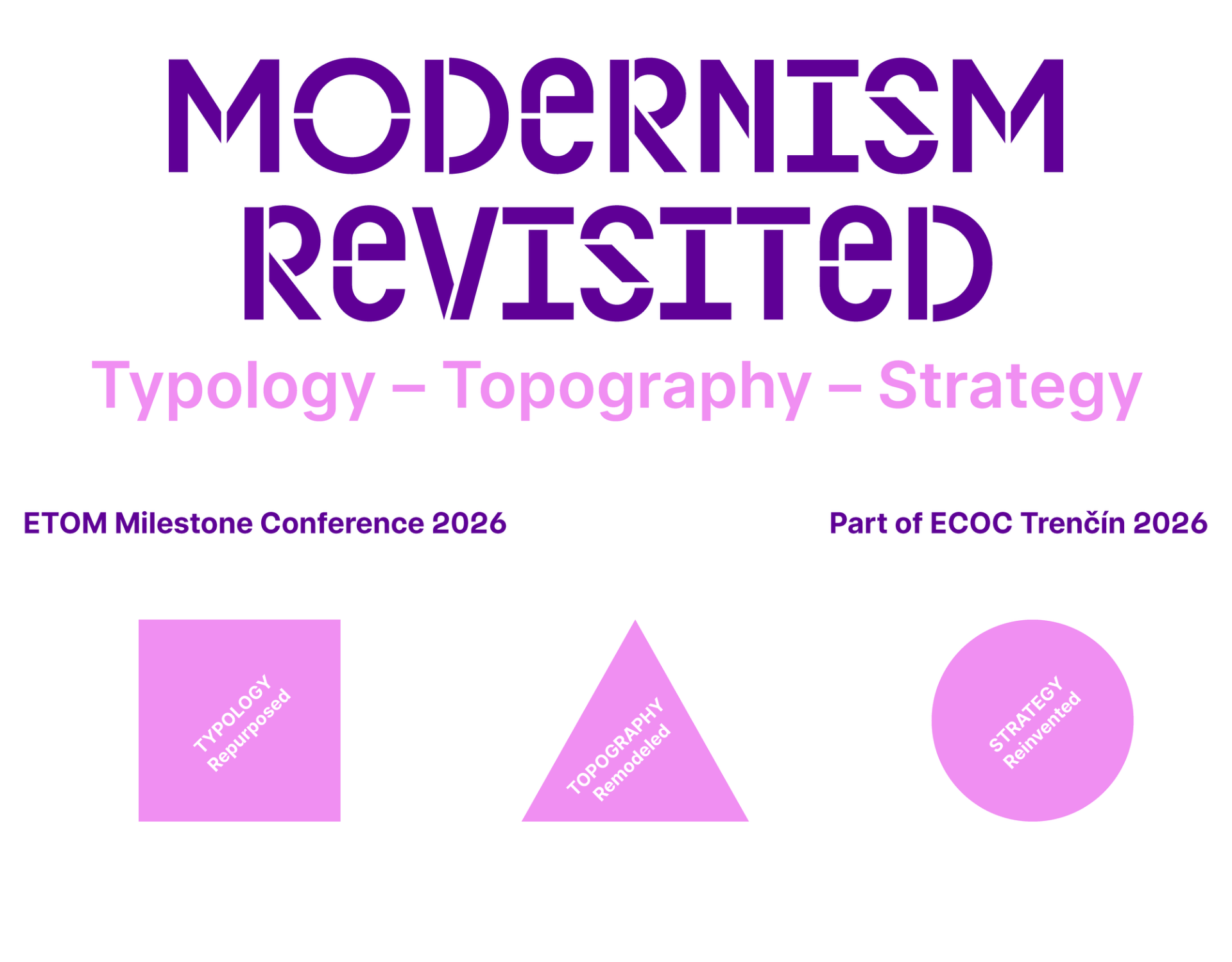
Modernism Revisited: Typology – Topography – Strategy
ETOM Milestone Conference 2026
Under the auspices of DOCOMOMO International and the Slovak Chamber of Architects
21–23 October 2026 — ODA Trenčín
Modernism Revisited 2026, held within the official programme of ECOC Trenčín 2026, invites scholars, architects, planners, educators, researchers, and policymakers to reflect on how modernist architecture, landscape, and planning visions can be reinterpreted and reactivated in the twenty-first century. The conference seeks an interdisciplinary dialogue across time and scale—linking architectural form with territorial context, and historical experience with contemporary and future scenarios. This conference is organised by the Jaromír Krejcar Society and the ETOM NEB Lab partnered with DOCOMOMO Slovakia.
Modernism—both as a historical movement and as an continuous architectural, technological, and cultural layer—continues to shape how we build, inhabit, and imagine the world. Emerging from diverse political, climatic, and cultural contexts—from liberal democracies to state-planned economies—in the past century generated a wide spectrum of approaches to architecture, urbanism, and life.
Today, these multiple legacies face new realities: ecological transitions, demographic shifts, and the transformation of once-public infrastructures and institutions. While mere technocratic, aesthetically formalistic and ideologically dogmatic conceptions of Modernism did not survive. The theories, practices and ideologies of modern thinking continue to shape our realities, while being constantly challenged and questioned. In order to challenge the current multicrisis, the humanist, emancipatory and social aspects need to be considered. The legacy of Modernism lives on as a structural framework to be filled in with contemporary ideas.
Contributions are invited under three thematic lenses:
Topography — Remodeled
Topography considers Modernism within its landscape, climatic, social, environmental and territorial settings. It focuses on the modern environments and its (r)evolution within the ecological systems, infrastructures, and communities. This theme invites perspectives on how modern architecture and planning transformed, and continues to interact with, the physical and social geographies that surround them—in different scales and contexts.
Topics include:
Modern landscapes, regions, and territorial structures
Environmental and social ecologies of modern sites
Stakeholders, communities, and the dynamics of intervention
Changing visibility, accessibility, and representation of modern environments
Interactions between built form, infrastructure, and natural systems
Reaction to changing climatic conditions
Strategy — Reinvented
Strategy explores how modern legacies can be re-engaged through contemporary design practice, education, research, and policy-making. This theme invites forward-looking and interdisciplinary approaches that respond to today's ecological, technological, and social transformations. Strategy also welcomes historical and contemporary examples from practice and pedagogy that translate modern principles into contemporary conditions of experimentation, collaboration, and care.
Topics include:
Adaptive reuse, revitalization, preservation and transformation of modern heritage
Ecological and socio-economic frameworks for sustainable modernization
Innovative methodologies in design, planning, and heritage management
Governance, policy, and collaborative approaches to complex environments
Education and practice as agents of transformation
Speculative and critical scenarios for future forms of living, dwelling, and production
Typology — Repurposed
A critical notion of Typology explores Modernism through the lens of architectural form and organization. It revisits the models, concepts, and systems that once structured public, collective or private spheres of life and asks how they can be understood and reimagined across different cultural, climatic, and political settings, through shared and personal experiences. Typology is approached not only as a technical or historical notion, but as a conceptual framework that connects design thinking with broader questions of social organization and transformation.
Topics include:
Architectural and spatial typologies of Modernism — social infrastructure, recreation, culture, administration, education and health
Typology as a conceptual or methodological approach in design and planning
Reinterpretations and transformations of collective living and standardised forms
Typologies as "organizational models of life," linking architecture to social and political structures
(Dis)continuity, hybridisation and mutation of typological thinking across regions and periods
Cross-cutting Questions
What does Modernism mean today? Is it still a living concept or a historical notion? Which legacies and interpretations of Modernism remain relevant?
How can Modernism be reinterpreted and reactivated for contemporary and future challenges?
How should we transform the methods of modern investigation in the face of current challenges?
What new trajectories—architectural, speculative, experimental, ecological, social, ethical and political—can its legacies open?
How do historical typologies engage with diverse climates and societal needs today?
Which transformations, whether successful or contested, provide insight for future practice?
Deadline Schedule
02 December 2025 — Open Call for Abstracts
09 February 2026 — Call for Abstracts deadline
30 April 2026 — 1st version of the final Paper submission deadline
15 June 2026 — 2nd final version of the paper submission deadline
15 September — Exhibition Elements, ODA Trenčín
21–23 October 2026 — Conference, ODA Trenčín
Costs: There is no conference participation fee. Travel, accommodation, and meal costs are the responsibility of each participant.
Conference Programme
The international conference Modernism Revisited 2026 brings together researchers, architects, historians and heritage professionals focusing on the legacy and contemporary interpretation of modern architecture.
The programme will include:
- keynote lectures by invited international speakers
- thematic academic sessions
- panel discussions
- presentations of current research and conservation projects
- guided visits related to modern architecture in Trenčín
- networking opportunities for participants
The detailed conference programme will be published soon.
Accompanying programme: ELEMENTS, exhibition in the public space in front of ODA Trenčín 15.09. - 4.11.2026
ELEMENTS is an outdoor exhibition presenting full-scale replicas of selected architectural elements from the Machnáč Sanatorium in Trenčianske Teplice — one of the most important works of interwar Modernist architecture in Central Europe.
The exhibition focuses on the individual elements that define the character of Machnáč — architectural details, materials, and design solutions that reveal the precision, craftsmanship, and conceptual clarity of the original building. Presented outside their original context, these fragments invite visitors to rediscover the values embedded in modernist architecture and to understand the importance of preserving its material heritage.
Keynote Speakers

Beatriz Colomina
Princeton University

Henrieta Moravčíková
Slovak Academy of Science

Wessel de Jonge
TU Delft
Scientific Board
Henrieta Moravčíková
Slovak Academy of Science

Uta Pottgiesser
Chair DOCOMOMO International, Delft University of Technology

Ákos Moravánszky
ETH Zürich

Ana Tostões
Técnico - University of Lisbon

Robert K. Huber
NBHROX bauhaus reuse, Berlin

Petr Vorlík
Czech Technical University in Prague

Dániel Kovács
KÉK, Budapest

Zuzana Duchová
Jaromír Krejcar Society
Executive Board

Martin Zaiček
Jaromír Krejcar Society, director

Mária Novotná
Curator, conference coordinator
Zuzana Pastirčák Duchová
Curator & media

Veronika Rabatinová
Production

Andrea Kalinová
AIR coordinator

Venue
ODA – Officers' House of the Army (Posádkový klub)
Hviezdoslavova 205
911 01 Trenčín
Slovakia
The Okruhový dom armády (ODA) is the main venue of the Modernism Revisited 2026 conference.
Designed by Ivan Kočan, Eduard Horváth and Dušan Bálent (1977–1978, completed 1985), the building is a distinctive example of late modernist architecture with brutalist influences in Slovakia. Its monumental stone-clad volumes were conceived as a cultural and representative centre in the new modern urban core of Trenčín.
The building contains several large halls and conference spaces, including:
- a main theatre hall with capacity of approx. 580 seats
- a conference and event hall for approx. 300 participants
- additional seminar and meeting rooms in the adjacent Garrison Club
Interior spaces include original design elements and artworks, most notably a monumental mural by artist František Gajdoš in the foyer.
REGISTER HERE
Recommended Accommodation
Hotel Elizabeth
Gen. M. R. Štefánika 2
911 01 Trenčín
Slovakia
A historic hotel located directly beneath Trenčín Castle, within short walking distance of the conference venue.
Hotel Deloris
Palackého 29
911 01 Trenčín
Slovakia
A boutique hotel located near the city centre with convenient access to the conference venue.
Due to limited accommodation capacity in the city centre, participants are encouraged to book their accommodation early.
Travel to Trenčín
Trenčín is located in western Slovakia and is easily accessible from major Central European cities.
By train:
Direct railway connections link Trenčín with Bratislava, Vienna, Prague and Žilina.
By car:
The city is located near the D1 motorway connecting Bratislava and Žilina.
Nearest airports:
- Bratislava Airport – approx. 120 km
- Vienna International Airport – approx. 160 km
About Trenčín
Trenčín is a historic city in western Slovakia located on the Váh River and dominated by the monumental Trenčín Castle.
The historic core of the city is centred around Mierové Square with colourful townhouses, cafés and public spaces beneath the castle rock. Beyond its medieval heritage, Trenčín also contains an important layer of 20th‑century architecture reflecting the social and urban transformation of the modern period.
In 2026 Trenčín holds the title of European Capital of Culture, bringing an extensive programme of cultural events, exhibitions and international collaborations to the city and its region.
Trenčianske Teplice
Only 15 km from Trenčín, the spa town of Trenčianske Teplice is one of the most renowned spa destinations in Slovakia.
Often called the "Pearl of the Carpathians", the town combines thermal mineral springs, historic spa architecture and landscaped parks. Visitors can explore an ensemble of spa buildings from the 19th and 20th centuries including the distinctive Moorish-style Hammam bath and several modernist spa structures.

Machnáč Sanatorium
One of the most important modernist buildings in the region is the Machnáč Sanatorium in Trenčianske Teplice, designed by the Czech avant‑garde architect Jaromír Krejcar.
The building was designed in 1929 and completed in 1932 as a spa and rehabilitation facility. It is considered one of the most significant examples of functionalist architecture in Slovakia and Central Europe.
The sanatorium is characterised by a reinforced concrete structure, ribbon windows and terraces reflecting the principles of modernist architecture focused on hygiene, sunlight and functional efficiency.
Jaromír Krejcar Society
The Jaromír Krejcar Society is a non‑profit organisation dedicated to research, protection and promotion of modern architecture, particularly the legacy of architect Jaromír Krejcar.
